Have you ever felt like your body and your mind were speaking two different languages? In our fast-paced, digital-heavy world, it’s common to feel a bit “disembodied.” We spend hours staring at screens, our thoughts racing at a million miles an hour, while our physical selves sit static and tense.
If you’ve been searching for a way to bridge that gap—not just through a gym workout or a seated meditation, but through something more rhythmic and expressive—you might have come across the word Eurythmy.
At first glance, it looks a bit like slow-motion dance or perhaps a more fluid version of Tai Chi. But Eurythmy is its own unique category. It is often described as “visible speech” or “visible song.” It’s an art of movement that aims to make the invisible forces of language and music tangible.
In this guide, we’re going to explore Eurythmy in a grounded, simple way. We’ll look at what it is, where it came from, and how it’s being used today to help people find a sense of balance and well-being.
The word “Eurythmy” comes from Greek roots meaning “harmonious rhythm.” It was developed in the early 20th century by Rudolf Steiner, the Austrian philosopher who also founded Waldorf education and Biodynamic agriculture.
Unlike dance, which often focuses on personal emotional expression or athletic performance, Eurythmy is based on the idea that every sound we make when we speak—every vowel and every consonant—has a specific “gesture” in the air.
When we speak, our larynx moves in specific ways to create sounds. Eurythmy takes those internal, microscopic movements and expands them into the whole body. When a eurythmist moves, they aren’t just dancing to music or poetry; they are trying to become the music or the poem.
Eurythmy isn’t just one thing; it’s a versatile tool used in three main areas of life:
In Eurythmy, every sound has a character. By moving these sounds, we can tap into different “energies” within ourselves.
By practicing these gestures, we aren’t just “exercising” muscles; we are engaging our nervous system and our “vitality” in a way that feels deeply restorative.
You don’t need to be an artist or a philosopher to get something out of Eurythmy. In a grounded, everyday sense, the benefits are very practical:
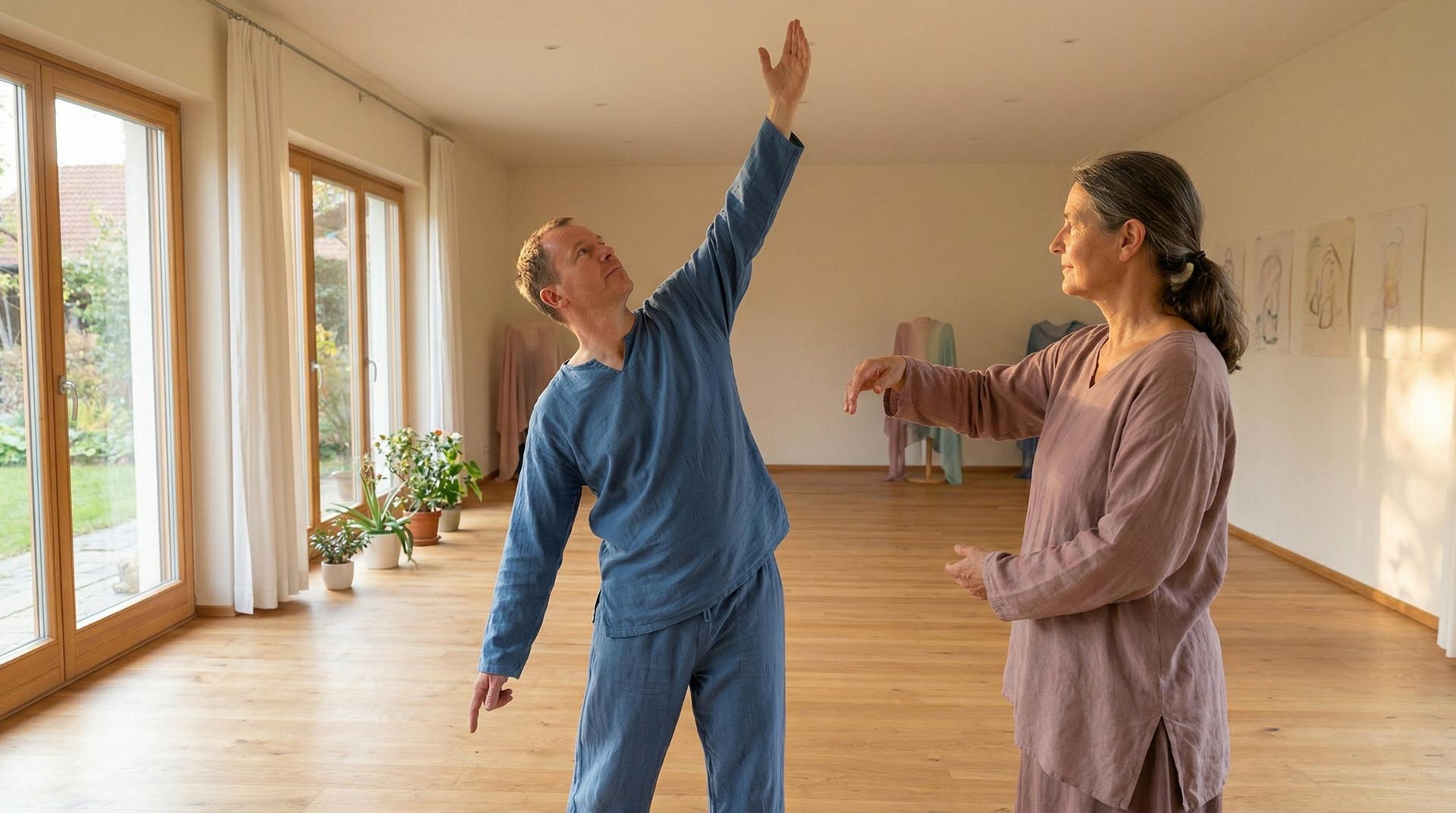
If you were to join a beginner’s class, you wouldn’t be expected to wear a silk veil! Usually, people wear comfortable clothing and soft-soled shoes (or copper-toe eurythmy shoes).
A typical session might include:
The atmosphere is usually quiet, focused, and very calm. There’s no “right or wrong” in a competitive sense; it’s about how the movement feels inside you.
Because it’s a bit unusual, there are a few myths worth clearing up:
While it’s best to learn from a teacher, you can try a very simple “Eurythmic” moment right now.
Stand up straight and take a deep breath. Slowly raise your arms out to your sides and up toward the sky in a wide arc, as if you are welcoming the morning sun. As you do this, quietly say the sound “Ahhhhh.” Feel the expansion in your chest and the reach in your fingertips. Then, slowly let your arms fall back to your sides as you exhale.
That simple moment of connecting a sound, a breath, and a gesture is the heart of Eurythmy.
Eurythmy reminds us that we are more than just brains carrying around a body. We are rhythmic beings living in a rhythmic world—from the beat of our hearts to the cycle of the seasons.
In a world that often feels fragmented, Eurythmy offers a way to feel “whole” again. It’s a gentle, grounded path toward finding harmony within ourselves and with the world around us.
WhatsApp us