In our modern pursuit of wellness, we often look inward—at our habits, our chemical balances, or our childhood memories. We spend years in talk therapy deconstructing our personal “story.” But what if the patterns that hold us back aren’t entirely ours? What if the heavy cloak of anxiety, the recurring financial struggle, or the inability to find lasting love is actually a silent inheritance from a grandfather we never met or a tragedy our family “forgot” to talk about?
This is the foundational premise of Family Constellations, a therapeutic approach that has moved from the fringes of alternative healing into a widely respected method for resolving deep-seated systemic trauma.
If you’ve felt like you’re living a life that isn’t quite your own, or if you’ve noticed “glitches” in your family tree that seem to repeat generation after generation, this exploration into the Family Constellation method is for you.
Developed by German psychotherapist Bert Hellinger in the 1990s, Family Constellations is a “systemic” therapy. Unlike traditional psychology, which focuses on the individual’s psyche, this method views the individual as part of a larger whole—the family system.
Hellinger observed that family systems, much like biological ecosystems, have a natural order. When this order is disrupted—by an “exclusion” (such as a forgotten child, a banished relative, or a hidden crime)—the system tries to compensate. Often, a member of a later generation will unconsciously “step into the shoes” of the excluded person, repeating their fate or carrying their emotional burden to bring the system back into balance.
This phenomenon is known as Systemic Entanglement.
To understand how a “Constellation” works, one must first understand what Hellinger called the Orders of Love. These are the “natural laws” that allow life force to flow through a family.
When these laws are violated, the result is often what we experience as “stuckness” in our adult lives.
One of the most striking aspects of Family Constellations is the process itself. It is rarely done through talking. Instead, it is a phenomenological process—meaning it is based on what is felt and observed in the present moment.
The Setup
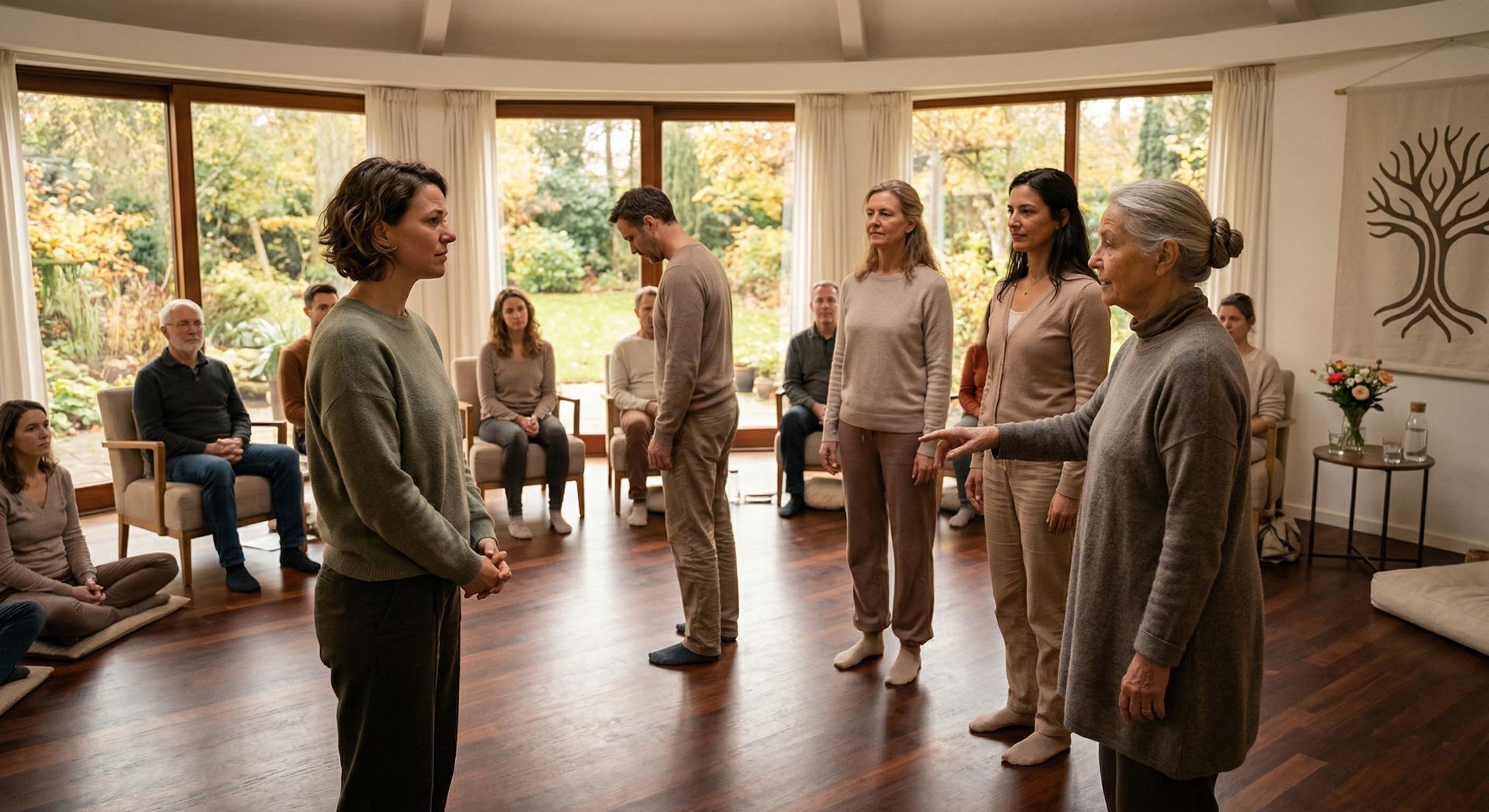
In a group workshop, a “Seeker” (the person working on an issue) is asked to select “Representatives” from the group to stand in for their family members—perhaps their mother, father, a deceased sibling, or even an abstract concept like “Success” or “The Secret.”
The Spatial Map
The Seeker places these representatives in the room according to their intuition. They don’t tell them how to act; they simply place them. This creates a physical “map” of the Seeker’s internal image of their family.
The Phenomenon of Representation
This is where the practice often feels “mystical” to newcomers. Once placed, the representatives begin to experience physical sensations or emotions that belong to the actual family members they are representing—even though they know nothing about them. Hellinger called this the “Knowing Field.”
A representative might feel a sudden weight in their chest, a desire to turn away from the “father,” or an inexplicable feeling of grief. By observing these movements, the facilitator can see where the “tangle” lies.
Imagine a woman—let’s call her Sarah—who suffers from chronic, unexplained sadness. In her Constellation, representatives for her mother and herself are placed. The representative for the mother is staring at the floor, unable to look at Sarah.
Through the process, it is revealed (or intuitively felt) that the mother lost a sibling in early childhood who was never mourned. The mother’s energy is “looking at the dead.” Sarah, out of unconscious love, is “looking at her mother’s sadness,” effectively living her life with one foot in the grave of an uncle she never knew.
The resolution comes when Sarah can acknowledge the uncle, give him a place in her heart, and then say to her mother: “You are the big one, I am the small one. I leave this grief with you and the ones it belongs to, and I look toward my life.”
Family Constellations isn’t just for “family problems.” Because we carry our family system into everything we do, it can be used for:
Traditional therapy often keeps us in our “adult” logical mind. We analyze the why. But trauma isn’t stored in the logic center; it’s stored in the nervous system and, as some argue, in our epigenetic expression.
A Family Constellation bypasses the story. It provides a soul-level image of a new reality. When a Seeker sees their “father” finally stand tall and put a supportive hand on their shoulder (even if their real father is deceased or abusive), the brain and body register a new experience of safety. This “Resolution Image” becomes a source of strength that the Seeker carries forward.
For those with a skeptical mind, the idea of a “Knowing Field” can be hard to swallow. However, modern science is beginning to bridge this gap through the study of Epigenetics. We now know that the effects of trauma—such as the chemical markers on DNA—can be passed down through at least three generations.
Family Constellations acts as a ritualized way to address these inherited markers. Whether you view it as a spiritual intervention or a profound form of “systemic roleplay,” the results are often undeniably tangible: a sudden shift in a stagnant relationship, a disappearance of a long-held fear, or a newfound sense of belonging.
If you are curious about trying this work, here are a few tips:
We are all the “front line” of a long line of ancestors. We carry their triumphs and their tragedies in our very cells. Family Constellations doesn’t ask us to blame our parents or dig up old bones for the sake of drama. Instead, it invites us to look at the past with respect so that we can finally leave it behind.
By giving everyone their rightful place, we find our own. And in finding our place, we finally become free to live a life that is truly, authentically ours.
WhatsApp us